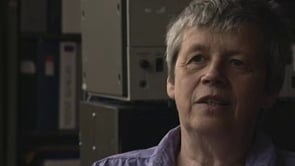
Steina talks about early rejection of video as an art form, working within the contemporary art scene.
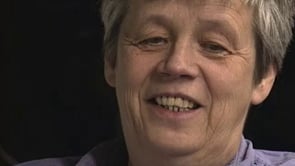
Steina talks about the process of making videos, sharing tapes, festivals, and when these practices began to taper away.
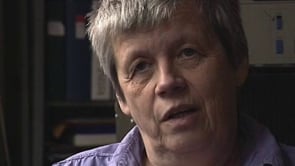
Steina talks about early reel to reel tape experiments, making loops, delays, and how these experiments were equally pursued in audio and video.
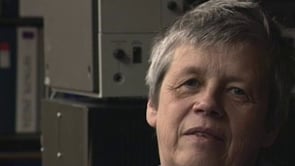
Steina discusses her choice of image material and how she reacts to different settings.
Steina talks about her background in music, relying on what you know, working with multi-channel video, and thinking in musical terms with visual materials.
Steina talks about the different ways of moving an image and her collaborations with Woody that lead to multi-axis camera movements used in the 'Theater of Hybrid Automata'.
Steina talks about the tape recorder as an essential tool in recording long-form video experiments for later review.
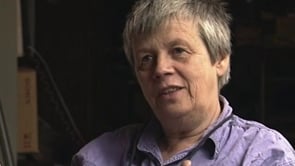
Steina discusses her musical background and perspectives on training as a soloist, her early experiences in New York City as a professional musician and the alternatives afforded by video.
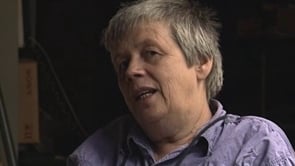
Steina compares multi-channel installations to single-channel tapes, noting her changing use of each through time. Steina discusses her views on "playing" and her methods for resolving works-in-progress.
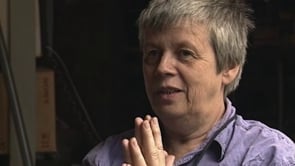
Steina describes her experiences with video as an accessible alternative to film and the prevalence of industry support she witnessed in developing artist's video works.
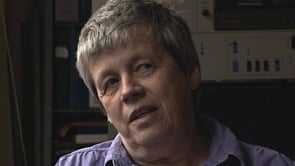
Steina describes early video feedback experiments and Automation House, a New York City venue that was an early model and source of audiences for The Kitchen, where La Monte Young was the first performer.
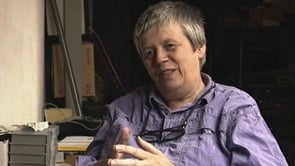
Steina talks about unknowingly renting Morton Subotnick's Buchla synthesizer, their first tests with video as a control voltage for audio synthesizers and meeting Rhys Chatham, the first musical director of The Kitchen.
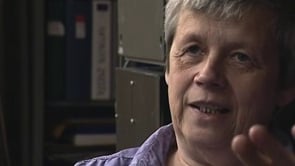
Steina describes their early interest in the unification of image and sound, the differences between the early analog versions of 'Violin Power' compared to later MIDI violin controlled performances, her need for spontaneity and play when making work and the rigidity of "official art".
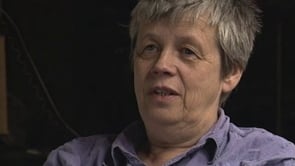
Steina describes seeing the Erik Siegal colorizer at the 1969 Howard Wise Gallery show " TV as a creative medium" and how they subsequently started working with engineer George Brown designing and building a dual-channel colorizer, a keyer and a flip-flop switcher.
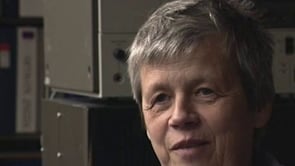
Steina describes their use of video as a means of understanding the world, the dialogue between tools/material/mind and the philosophy of Woody's constructions.
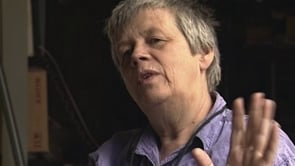
Steina discusses compositional strategies for making new videos and her techniques for constructing multi-channel video installations.
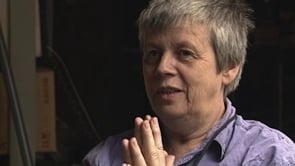
Steina talks about the inexpensive access to video equipment in the early years of video, and the collegiality between practitioners.
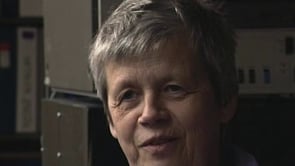
Steina talks about developing the real-time image processing software Image/ine with Tom Demeyer while acting as Artistic Director at STEIM in Amsterdam in 1996.
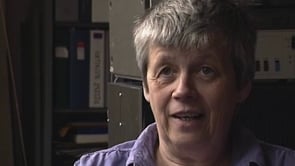
Steina describes entering the Electronic Age through audio, their initial explorations with tape delay, harnessing audio feedback and their interest in using audio synthesizers as a tool for creating videos which allowed sound-from-image and image-from-sound possibilities.
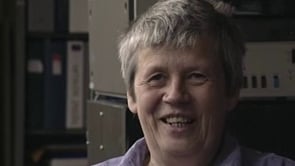
Steina describes early collaborations with Woody, later collaborations with Joan La Barbara, Tom Joyce and Doris Cross and the construction of the Digital Image Articulator with Jeffrey Schier.

Woody Vasulka gives a talk to museum trustees during a tour of the Machine Media exhibition at the Museum of Fine Arts, Santa Fe New Mexico. Works featured in the video are 'The West', Theater of Hybrid Automata', 'Table I', and 'Table III' from 'The Brotherhood' series.
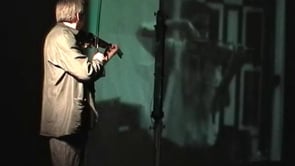
Steina performs 'The Maiden' from Woody's series 'The Brotherhood' at the NTT InterCommunications Center, Tokyo, Japan 1998.
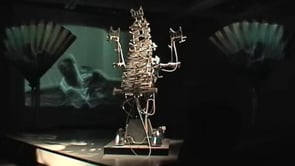
Steina performs 'The Maiden' during Woody Vasulka's exhibition of 'The Brotherhood' series at the NTT InterCommunications Center in Tokyo, Japan (1998).
After the performance Steina gives a short demonstration, which is translated in Japanese, on how she uses the violin to perform and control video and sound, and 'The Maiden'.